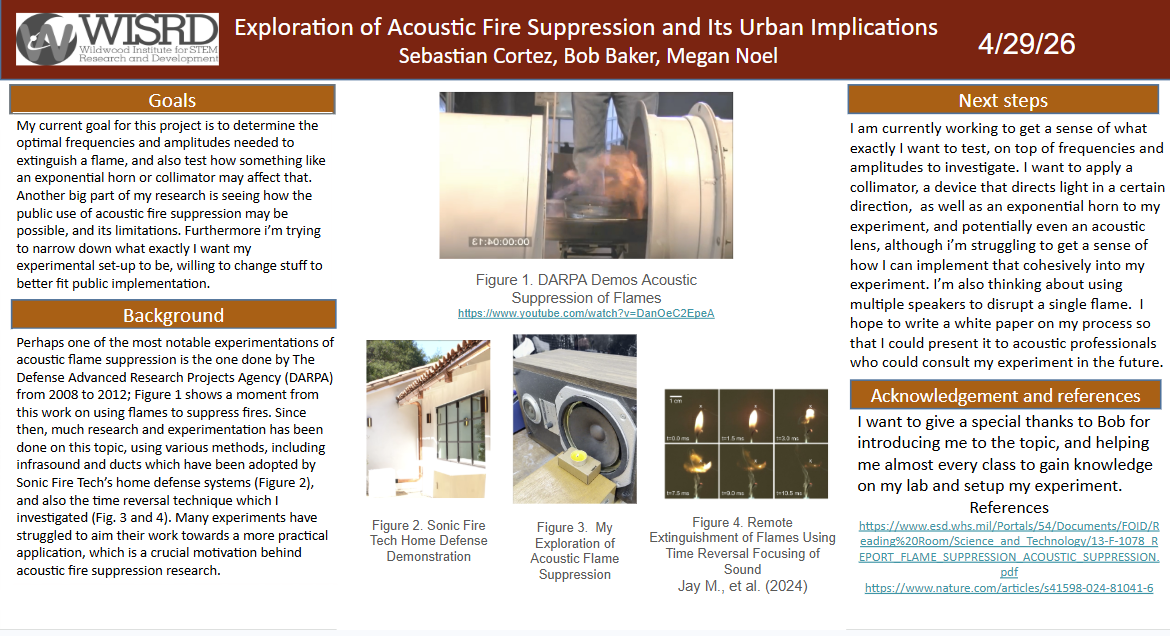
Putting Out Fire With Acoustics
Sebastian C.
Journal
9/28: Today I want to get the successful subwoofer setup to work a bit better as last time I observed that the wave generator made it very easy for the subwoofer to start clipping, probably because it wasn’t very precise. I would also like to get a better understanding of the amplifier settings like crossover and bass boost.
9/24: I’ve tried every combination of amplifier, power supply, and wave generator and nothing has been able to be able to power the amplifier we have. It’s been two months since i’ve started trying, I originally powered the setup with 12-volt Yeti DC battery but I soon found out that the amplifier couldn’t draw enough current from it, as the battery wasn’t compatible with the amps average musical current draw. Furthermore, the amp needed an 8-gauge wire for its power input which we originally weren’t using. The goal of the setup was to get the subwoofer to work compactly which was why having a battery to power the amp was optimal, although a battery that would be able to effectively power the amplifier would be too expensive. This is why we purchased a cheap 12-volt 50 amp 600W AC to DC power supply to power the amp, and even though it wasn’t compact, at least it could show us that the amplifier could work. Even with the new power supply, nothing seemed to be working. So we switched the wave generators, used a duplicate of the amplifier in case one was defective, and tried it connected and not connected to the subwoofer. What ended up getting us to turn the amplifier on was separating the +12v wire from the power supply into two wires, one connecting into the +12vDC input and the other into the remote. This got it to work because in a car setup, which is what this compact amplifier was designed for, you would typically need to connect the head unit to the remote input of the amplifier via the remote turn on wire to turn the amplifier on, which we mimicked the the +12v power input.
9/3: It’s a new school year and i’m proud of myself because I really picked up where I left off. I’m still trying to power the subwoofer with a compact setup but that’s been especially difficult because we don’t have a lot of the proper supplies in WISRD. For example the compact amplifier we bought isn’t drawing enough current from the YETI 12-voly battery we have, so we have to purchase a compatible one. In the search for a compatible one I realized there is a lot I have to consider when buying it especially because the amplifier is meant to be powered by the car, so I ended up just contacting tech support from the audio company. Hopefully I have some luck in that and moving forward I want to continue to build a compact setup including a small wave generator which we have but don’t know if it works yet. After that I will focus on building a collimator and making the subwoofer more efficient for what I want it to do.
5/1: I know I states I wanted to simplify my experiment and just test frequencies, amplitudes, and waveguides, but I believe I could do so much for for the development of acoustic fire suppression if I would just take a look at current models, see how they work, and then see how I could possibly improve them and make them more applicable to a practical setting. So next week I definitely want to invest some time into that.
4/14: I’ve continued to put my ideas in the dock and do polishing research, but most of my time has been dedicated to making my journal much cleaner and organized, until I journal again, I will be hard at work on Squarespace.
4/1: I’ve really been trying to narrow down my experimental set-up to try and get this experiment going so i’ve started putting my ideas in this doc.
https://docs.google.com/document/d/1jc0c1AV6zeiU7_5w03vQeyX0j_8sR5_ZbeI-vx2Ulck/edit?tab=t.0
3/18: I’ve been looking at more papers with an intent to really get somewhere in my own experiment, I’ve seen the use of collimators in some experiments which interests me, and I think it’s a nice way to add a bit more complexity to my experiment with it still being feasible, so I’m going to be doing some research on the topic of collimators and horns to become knowledgeable enough to introduce it to my experiment.
3/1: Originally I wanted to find the best system to extinguish fire with a focus on urban environments, but I realized that each system had it’s own “project in it” and I would have never gotten anywhere if I wanted to consider all experimental set-ups. So I believe I want to focus on how different frequencies and amplitudes effect flames, and just simplify my original experiment so It can be more feasible.
2/20: I’m reading many papers on acoustic fire extinguishment, trying to figure out what I want my own experiment to be and I believe i’m getting a little bit lost trying to focus my research, i’m kind of just going back and forth and searching up words and physics, which i’m definitely learning from, but I also am really ambitious to come up with a plan for my experiment.
2/12: I’m fascinated with the idea of the time reversal technique to extinguish fire, it concentrates the sound in one area and I want to explore it more to see if I could possibly implement it into my own project. Furthermore I’m looking more deeply into the physics of how sound can put out fire including acoustic streaming and acoustic oxygen displacement.
1/25: I’m starting to consider the possible flaws in using sound to put out fire, especially in urban environments, considering humans could be harmed with the amount of sound potentially needed to put out fire, especially form greater distances. Infrasound could ideally fix this issue but it’s never been implemented through any systems other than ducts, like the ones used by Sonic Fire Tech, and plus it’s also a touchy subject in terms of human safety if used in crowded urban environments, but it’s definitely something I want to test.
1/12: I came to the conclusion I could get most of the best knowledge on acoustic fire extinguishment through lab reports and research papers. I want to implement my findings to try and tackle real world problems that acoustic fire extinguishment could possibly solve. There are some cons of using water to extinguish fire, but nothing major especially considering the urgency of the situations it’s used for. I want to start going deeper into why it may be so beneficial to use sound to extinguish fire.
1/5: I’ve been looking for an interesting topic to explore but I haven’t been able to find something that interests me, until Bob showed me a video of these people putting out fire with sound in the form of this leaf blower thing. The physics and the topic fascinated me, and I knew immediately that I wanted to pursue it in the form of an experiment. So firstly I want to familiarize myself with the physics of the scenario so I can talk knowledgeably about my topic.
12/19/25: I’ve been doing work on the Aerospike for just about the whole academic year, and I’m proud of how consistent and engaged i’ve been, me and my partner really pushed the project forward all year round, but I have to say I’m burnt out. I can’t say i’m passionate about the work I do everyday anymore, so I want to find and explore a topic that I can come to WISRD everyday excited to learn about and implement into an experiment.

Physical Journal Entry on Acoustic Streaming
2026 Spring Poster Session